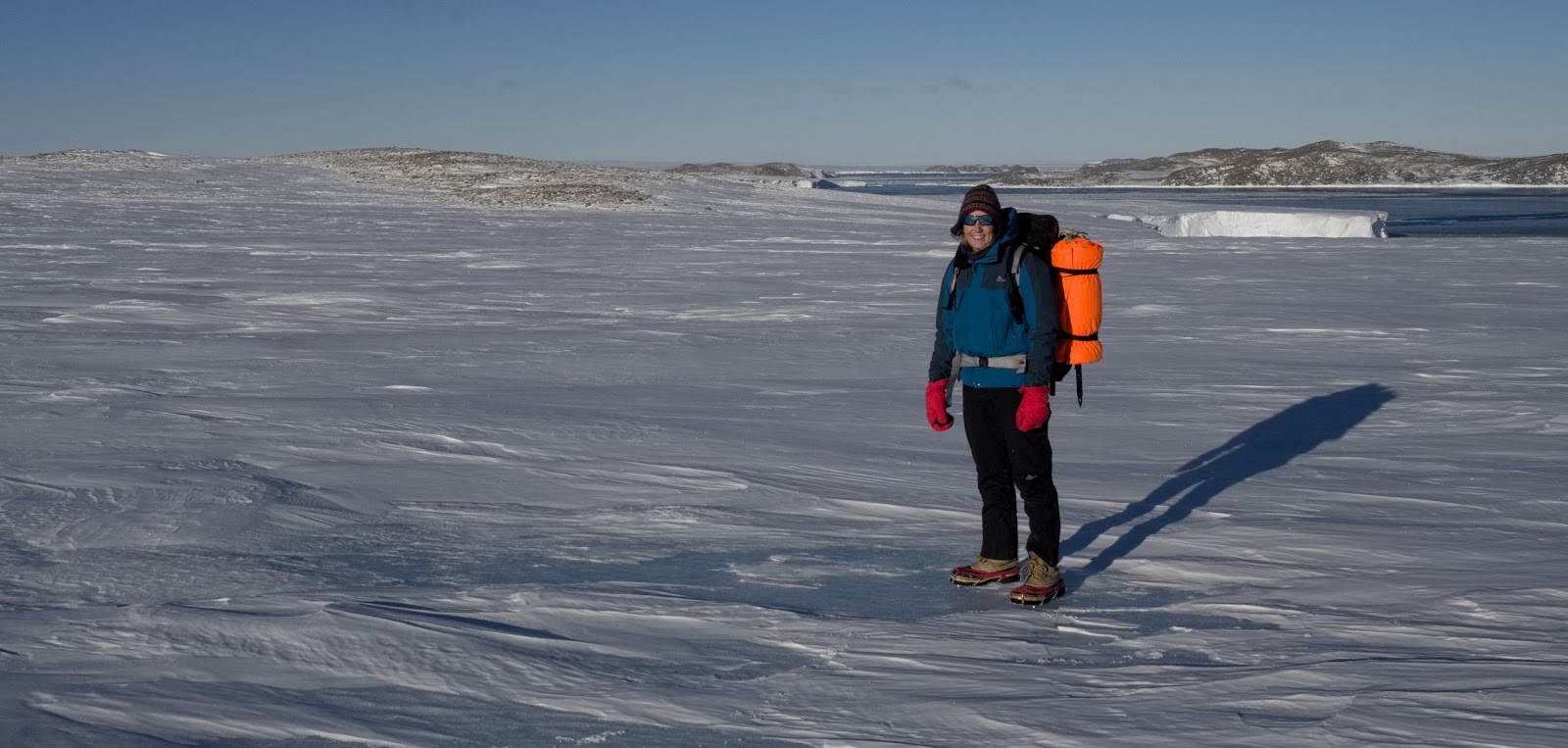
Recently I headed out to explore the Mitchell Peninsula (see
Windmill Islands Map 2 or 5) with a few of the crew on a beautiful sunny Sunday afternoon. One of the things about the Antarctic landscape is the feeling of unbounded space. Aside from the texture of snow, and the colour of the exposed ice, there are few features to catch your eye. Rocky outcrops and nunnatuks interject upon the dominating whiteness, providing a visual reference here and there, but on the whole a feeling of boundlessness prevails.
 |
Checking out the tide cracks at O'Brien Bay. Photo: Jacque Comery
|
 |
Sea ice ramp M-03 from the north side of the Mitchell onto O'Brien Bay. Photo: Jacque Comery
|
Whilst we normally travel along set cane line routes, the Mitchell Peninsula is one area that due to having less environmental hazards, is available for us to travel freely.
Such a strange feeling this is. As modern humans most of us spend our entire lives working within boundaries. Be they physical barriers, virtual no go areas established by rules and ownership, or barriers that we have created for ourselves in order to provide a structured world in which to operate, we suffer restriction. It is not until you are faced with such a wide open space that the weight of this truth is wholly apparent. Only those who have spent time on the open sea would understand this feeling of boundlessness. However the terrestrial experience is different.
 |
Sparkes Bay ice cliffs. Photo: Jacque Comery
|
 |
| O'Brien Bay. Photo: Jacque Comery |
For most of us, so comfortable in our structured worlds, the removal of guidance and limitation, creates an uneasiness. Where should I go first? And why? What should I do there?
Not only are we restricted in where we go, we also maintain a high degree of structure over ourselves in why we travel along our paths. When was the last time you wandered aimlessly with no objective. We are busily forging from place to place along set routes to achieve tasks, fulfil obligations, reach goals. Reflect on the last 24 hours and think about where you went. Why did you go there and how much freedom of choice did you enjoy in getting there, physical, or virtual.
My point you ask?
As I stood out on the Mitchell I realised that I could go in any direction on foot, cross no boundaries, challenge no territorial or ownership boundary, and it was strange. To feel overwhelmed by freedom of choice of movement; what a special thing to feel. Something that many people by way of environment, circumstance or by oppression of freedom will never know.
 |
View from Keny out to Warrington Island. Photo: Jacque Comery
|
 |
Above the ice cliffs looking over Sparkes Bay to Robinson Ridge. Photo: Adam Roberts
|
We expeditioners working with the Australian Antarctic Program, are lucky enough to work within a system which encourages recreation and exploration of our immediate environs, a luxury not afforded participants of many other nation's programs. So I grasp this opportunity wholeheartedly and make the most of it. This winter will probably be one of the few times in my life that I have the pleasure of feeling the remoteness, isolation and freedom from the modern world.
 |
Adam and I inside Kenny Hut. Photo: Andrew Donald
|
 |
| Sea Ice access ramp from M-04 onto Sparkes Bay ( The black shap on the ice floe is a seal). Photo: Jacque Comery |
 |
| A regurgitated Skua bolus tells a story of what these birds are feeding on. Photo: Jacque Comery |
 |
| Kenny and the Hagg. Photo: Jacque Comery |