Saturday, 22 April 2017

Window crystals

Moisture trapped in the double glazing is growing spectacular ice crystals and providing me much amusement....

Photo: Jacque Comery

Photo: Jacque Comery

Photo: Jacque Comery

Photo: Jacque Comery

Photo: Jacque Comery
 
Photo: Jacque Comery

Photo: Jacque Comery

Photo: Jacque Comery

Photo: Jacque Comery


Thursday, 20 April 2017

A little bit of greenery


With no fresh produce coming onto Station throughout the winter, our hydroponics set up is a delight in keeping some fresh ingredients on our plates. A team of Station volunteers tends to the litte indoor garden hidden away in a shipping container.
Antarctica really is quite devoid of smells, and walking into hydro is almost overpowering in its sweet aromas! Ahh fresh tomatos...say no more.

Chard. Photo: Jacque Comery

Some of the hydroponics set up. Photo: Jacque Comery

Lettuce. Photo: Jacque Comery

Tomatoes. Photo: Jacque Comery

Precious tomatoes. Photo: Jacque Comery
  
Lettuce and rocket. Photo: Jacque Comery

Greens! Photo: Jacque Comery

Wednesday, 19 April 2017

Snow Petrels


I spent a morning tucked up in the rocks on Reeves Hill with a thermos of coffee and my camera. My photos don’t begin to capture the beauty of these little birds as they darted and weaved performing their acrobatics along the rock faces, often flying within metres of me.

Snow petrels pair in a rock crack. Photo: Jacque Comery


Snow petrels Pagodroma nivea are an all-white, small fulmarine petrel with conspicuous dark eyes, small black bill and bluish-grey feet. They are circumpolar and are typically found near to pack ice. They are the most southerly breeding bird species, breeding even further south than the Emperor Penguin.

Snow petrel. Photo: Jacque Comery
Snow petrels nest in colonies on sea cliffs, taking advantage of crevices and cracks in rocks to build nests comprising a pebble lined scape. At sea they will feed on fish, squid, molluscs, but will also feed on carrion on land as well.
Skuas are the main predators of snow petrels, but they are also at risk of losing chicks and eggs to heavy snow blocking access to their nests.

Skua patrolling the cliffs. Photo: Jacque Comery
Some birds remain at the colony all year, but the main influx of birds to the colonies is from mid-September until early-November.
There are several colonies of snow petrels close to Casey, and we have the joy of seeing these nimble birds performing their high speed aerial ballet above Reeves Hill to the north of Station, their white feathers often lit up against dark and brooding skies.

  
Snow petrel flying amoungst the rock ledges. Photo: Jacque Comery

Take off. Photo: Jacque Comery

Snow Petrel pair. Photo: Jacque Comery

Gliding over the forming sea ice. Photo: Jacque Comery

Aerial eleance. Photo: Jacque Comery
Snow Petrels and a Skua. Photo: Jacque Comery


Cliff top vantage point. Photo: Jacque Comery

Aerial ballet. Photo: Jacque Comery


Friday, 14 April 2017

Dramatic skies.

From a dark and brooding morning, to an evening sunset which set the  ice aglow.
Casey showed me her extremes on the day that marked the end of my first month on Station.
An emphatic reminder that whilst living inside our insulated Antarctic buildings, you need to keep one eye on the great outdoors, even if just from the front door step, so as to not miss the  spectacle that nature unfolds for us every day down here.

Morning cloud over the Clark Peninsula. Photo: Jacque Comery
 This cloud over the Clark Peninsula was like a living beast, visibly rotating, rolling  along towards the north and intensifying in colour as it went. I had just walked out of the red shed to walk to work at the operations building to work, and captured this on my phone.

Sunset from the heli pad. Photo: Jacque Comery
In a scenario which was the reverse of my experience in the morning,  I walked out of the door of the operations building to walk home to the Red Shed, straight into this. I had not seen this sunset unfold from my office window which faces north, until I walked outside. So very glad I chose this moment to  head home for the day!

Thursday, 13 April 2017

The diminishing light.


"Do not go gentle into that good night.
Rage, rage, against the dying of the light."
Dylan Thomas, 1914 - 1953


Whilst possibly a little dramatic for our context, I still love the sentiment of Dylan Thomas's poem  Do Not Go Gentle Into That Good Night published in 1951. We are implored to live life to the fullest, and push back against anything that draws us towards surrender. 

Here the daylight is leaving us so quickly, The soft golden sunrises and striking orange sunsets, are becoming all the more pronounced, as the altitude of the sun diminishes.  The arc that it tracks across the sky to the north, casts long shadows, and treats us to beautiful displays as its rays shine out from below low cloud over the sea, dotted with ice bergs.

I am reminded to soak up every day down here, to appreciate this waning light, and the beauty that it illuminates. Each day now shall be darker than that before it, and the daylight upon our icy world will slip away.

We are currently losing  around 7 minutes of light a day. Almost 50 minutes per week. At its highest point the altitude of the sun is a modest 15 degrees, and is dropping 0.4 degrees per day  (2.8 degrees per week).

Check out this great website to follow our journey into twilight here at 66 degrees south.

https://www.timeanddate.com/astronomy/antarctica/casey


You can  manipulate the tools online to  check out the suns altitude and heading at any time of the day.

Reference: https://www.timeanddate.com/astronomy/antarctica/casey. Accessed 13-04-2017 at 1625 hrs

Reference: https://www.timeanddate.com/astronomy/antarctica/casey. Accessed 13-04-2017 at 1625 hrs


Tuesday, 11 April 2017

A week of sunsets from the heli pad.

Everyday for a week, I snapped a photo on my phone on my way home from work. The photos are taken from the heli pad outside of the Red Shed looking back along the road that leads to the operations building.  Interestingly, whilst i took these shots only a week and a half ago, it is already dark now at this same time of day.

Friday. Welcoming the weekend. Photo: Jacque Comery

Saturday. Sky on fire. Photo: Jacque Comery

Sunday. Low cloud on the horizon. Photo: Jacque Comery
Monday. Sun halo. Photo: Jacque Comery

Tuesday. Blue skies and sunset. Photo: Jacque Comery

Wednesday. Sun making a late appearance just as it sets. Photo: Jacque Comery

Thursday. Soft light and pretty clouds. Photo: Jacque Comery


Monday, 10 April 2017

Jack's Line Monday mission

The day started with a stunning sunrise, and stayed clear all day. I was on kitchen duty with Chef Andrew (Bongo) all day today, but in the afternoon, Mat came in and suggested that we should take a run  out to the Jack's Line and check that the route marking canes, that we installed last week survived the weekend blizzard.

The Jack's Line or J-Line as it is known is a route that leads out to Jack's Hut. With Mat and I in the blue hagg, and Chef Bongo and  Jimmy the aviation plant operator on quads, we headed out on the blue ice to check the canes.  The canes are to help give us a visual reference along our crevasse free travel routes. They comprise a bamboo cane, with a flag, and a recycled steel food can from the kitchen as a radar reflector.  They actually show up pretty well on the GPS radar units in the Hagglunds!

We installed one new cane, and the rest looked ok.
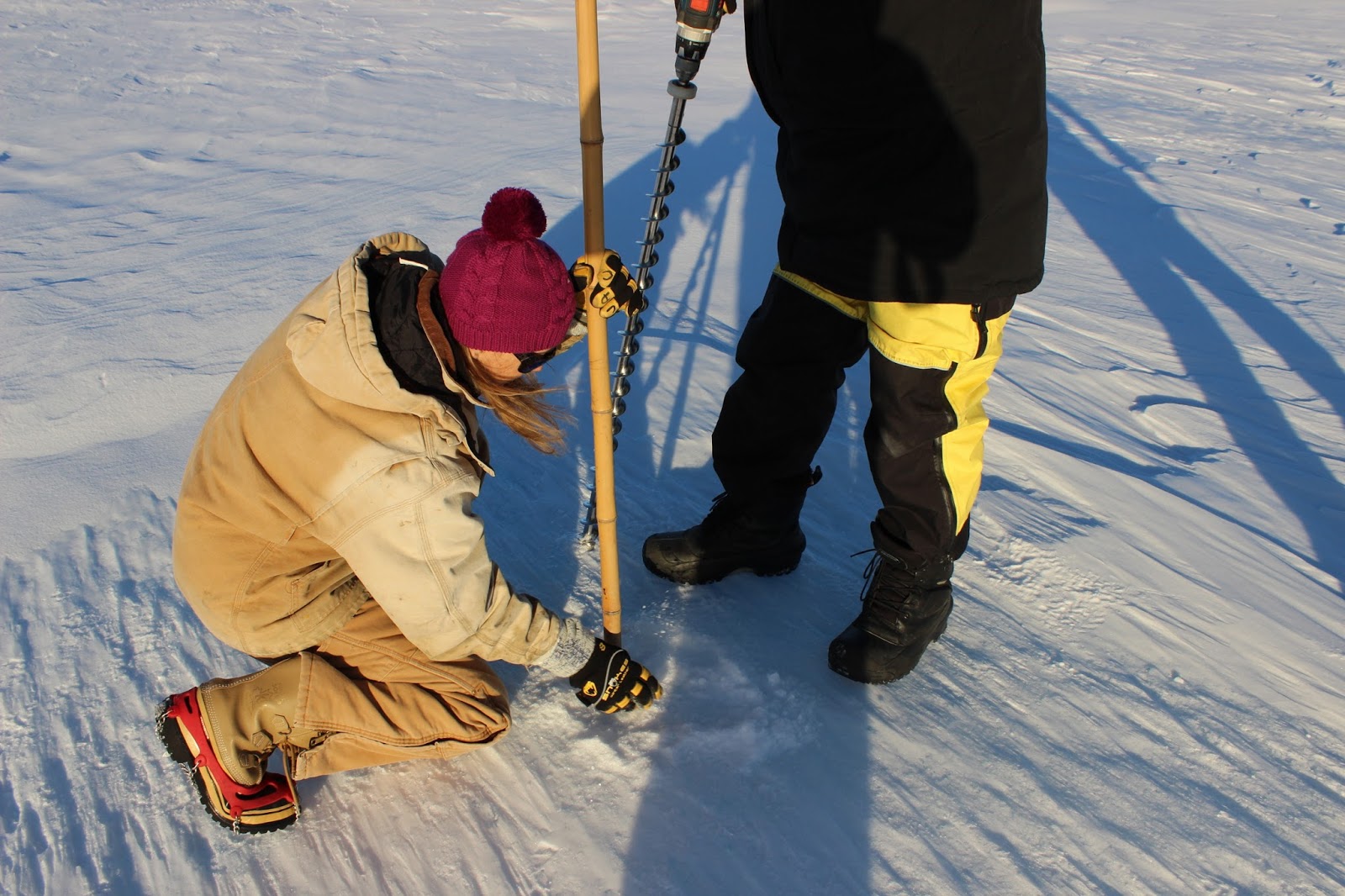
To install a cane we line up the hagg directly on our GPS travel line and measure out a distance of 15 m with a rope tied to the hagg, whilst the other person drills a hole into the ice to install the cane. We backfil the hole, water our bamboo tree and voila! one track marker cane installed.

Everyone loves power tools! Photo: Mat Callaghan

Crack cane line installation team. Photo: Mat Callaghan
 
Backfilling the drill hole. Photo: Mat Callaghan

Blue hagg on the blue ice. Photo: Jacque Comery